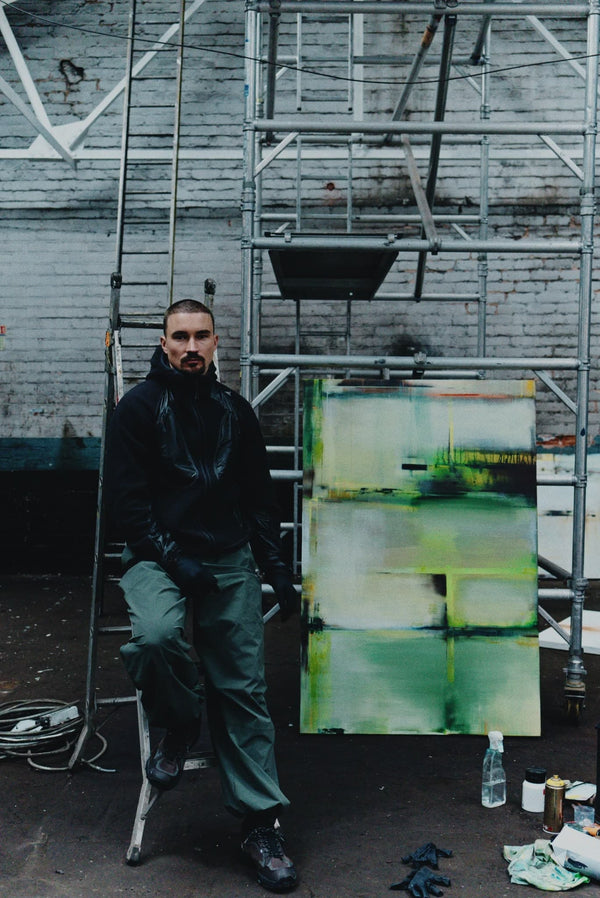
Art · VFC Studio Visit
Gabriela Giroletti
In conversation with Gabriela Giroletti on their work with 4BYSIX.


Thanks for working with us on Vehicles For Change.
To start, please can you give us a brief introduction to yourself and your practice for anyone who may be seeing your work for the first time?
I’m Gabriela Giroletti, a Brazilian artist based in London, where I live and work. My practice is primarily rooted in painting, and I’m interested in how we experience, perceive and make sense of the world around us.
I often think of my paintings as landscapes, although they don’t necessarily depict recognisable places. Rather than representing nature as something we observe from the outside, I’m interested in its underlying energy: the forces, movements and rhythms that shape the world around us. At the same time, I’m drawn to the tangible world and the physical reality of things: their textures, forms, and the ways we encounter them through our bodies and senses. I think of painting as a way of exploring the relationship between these physical experiences and the forces that shape them, translating them into colour, form and gesture.
My paintings emerge through an intuitive process of layering colour, shapes and textures, bringing together fragments of memory, observation, imagination and lived experience. I work predominantly with oil paint, allowing the paintings to develop through experimentation, improvisation and discovery.
Cutting into the surface became an important part of the process as it made it lose its rigid quality.


As your practice encourages the “viewer to formulate peculiar connections with our tangible surroundings”, can you tell us what drew you to working with 4BYSIX on this specific canvas?
What attracted me to collaborating with 4BYSIX on this canvas was the possibility of creating a piece that challenges the way we perceive and relate to our surroundings. My practice often explores the subtle tension between the familiar and the unexpected, finding new meaning in everyday elements through shifts in context and perspective. This canvas felt like an opportunity to bring that curiosity into a shared space, creating something that feels both grounded in the tangible and open to interpretation. I’m interested in leaving room for the viewer to make their own associations, allowing the work to become a personal encounter rather than something with a fixed meaning.


Given that your practice frequently explores the relationship between the painted image and its material presence, can you tell us how you found the process of working with the tarpaulin? Did the surface’s history influence the direction of the work in any way?
Working with tarpaulin was an interesting experience, particularly because of its sleek, synthetic surface, which creates a different relationship with paint than a traditional canvas. I was drawn to the contrast between the smoothness of the material and the physical presence of the painted image. I also decided to cut into the tarpaulin to give the work a more dynamic, almost living quality, breaking away from the flatness of the surface and allowing the material itself to become more expressive. There was something exciting about introducing this physical intervention into an otherwise smooth, industrial material. For me, it was a way of pushing the painting beyond the image itself, creating a tension between surface, material, and form.


Swipe for details


What more can you tell us about Folds? How did your practice, which normally uses natural materials and pigments, translate onto the surface?
I’m used to working with the textures that come from mostly natural materials (such as cotton canvas and wood), and I found it interesting to place this way of working against the sleek, synthetic surface of the tarpaulin. Rather than trying to make the material behave like a traditional canvas, I wanted to embrace this contrast. Cutting into the surface became an important part of the process as it made it lose its rigid quality. I was interested in how these interventions could shift the painting from a flat image into something more tactile and object-like such as my paintings, where the material itself becomes part of the visual experience.
What to read next