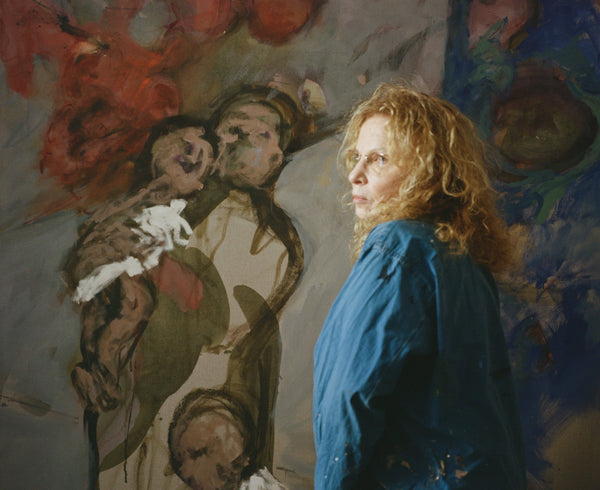
Art · VFC Studio Visit
Aleah Chapin
In conversation with Aleah Chapin on their work with 4BYSIX.


Thanks for working with us on Vehicles For Change.
To begin, how did growing up in your Pacific Northwest community shape the way you approach the human form, identity and the passage of time in your paintings?
I grew up in an environment where life had purpose and death wasn’t something to be afraid of. This was shown to me through an anchored awareness of the natural world and a curiosity about our place in it. In my early teenage years I was very sick, which brought me into my body in a way that I couldn’t ignore, but it also showed me that who I am is more than my physical form. That dynamic between the tangible and intangible is what drives the work I do.
When selecting your colour palette, do you tailor it to reflect the individual you are depicting, and if so, how does the personality or presence of your model influence that choice?
Color tells a story, and so does light. I choose my palette based on the emotional resonance I’m trying to convey. I often find myself drawn to that stretch between opposites, like the colors we see as day turns to night, or night into day.
Creation is the opposite of destruction, and that feels like the most important thing I can offer.


You recently made a new piece for 4BYSIX whose work aims to encourage sustainability within the visual arts. Can you tell us more about the work and if there is an instinctive connection between your practice and the natural world?
My work begins in the body and attempts to communicate through its language. When I thought about this project, I knew I wanted to make something that would speak about mutuality, affect, and support. The piece I made is of hands forming a sort of shelter, which is also a triangle, the strongest shape.


How did you find working on repurposed lorry tarpaulin? Did you find that the nature of the material influenced the direction of the final piece?
Conceptually and environmentally, I love this. I think the idea that the material was originally used as a protective shelter to help move things from one place to another had an influence on the final painting, although I wasn't aware of that connection until I finished.


Swipe for details


Lastly, how are you and how has life in the studio been for you recently? Are there any upcoming projects you would like to share with us?
I’m loving being in the studio these days and I’m in the middle of a new body of work. In terms of public projects, I recently made a piece for the Sound & Vision 2026 War Child Benefit, and I’m beginning a portrait commission for the National Portrait Gallery in London. The more pain and fracture I see in the world, the more I want to create, not from avoidance, but because creation is the opposite of destruction, and that feels like the most important thing I can offer.
What to read next