Art · VFC Studio Visit
Arthur Lemonier
In conversation with Arthur Lemonier on their work with 4BYSIX.


Thanks for working with us on Vehicles For Change.
Before we dive into your practice and the painting itself, can you take us to the beginning of your creative journey and explain how early experiences, such as working in the fashion industry, shaped the artist you are today?
Fashion was definitely what introduced me to art as a kid. I grew up wanting to be a fashion designer, looking up to designers and their muses. What I understand more now, decades later, is how much of a mark creative designers left on me: I was watching them build a new theme, world and story, sometimes an homage, for each collection, and that was inspiring. Painting came later as a better fit for me (or should I say outfit, lol) and I traded the markers on paper for paintbrushes on canvases. And I think this shaped me: the paint as a material, a tool, and the experience of it. Even if holding a brush can feel tough at times, it remains an extension of my hand.
You recently made a new piece on a section of repurposed lorry tarpaulin as one of 4BYSIX’s unconventional canvases. Can you tell us how you found the process, this piece and your choice of colour palette?
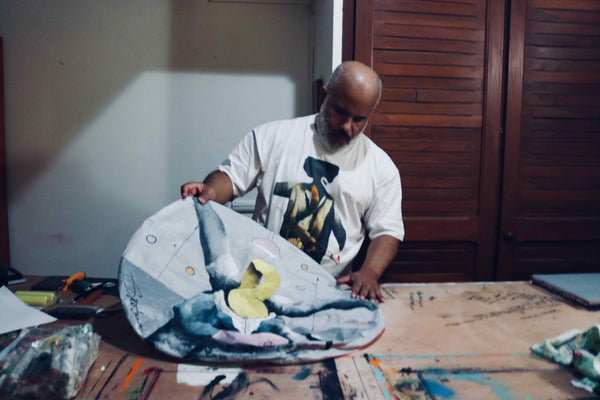
I was extremely surprised to discover the texture of the fabric, excited but also frightened, haha! People who know me in daily life know how close I am to second hand, vintage and repurposed items, and this experience unlocked a new level. During the process, I had to find a way to treat the material with a different approach, and for my brushwork to be satisfying for me, I had to bring back a bit of roughness to the tarpaulin. It’s really fascinating to see how much a surface and a different tool can shift your practice towards other directions and surprises.
For this piece I wanted to create a more muted palette, less filled with saturated colours. I mostly work in rebound, so this work was answering some questions from previous work. I think some pieces need to contradict one another in order to coexist.
I love how the piece cannot give me answers on how to feel. It’s a permanent suspended space.


Compared to your previous work, which you have described as sorrowful or confrontational in tone, this new painting centres on what you have called “a staring glare”. Were you consciously looking to create a different kind of encounter between the subject and the viewer?
Yes! I was in a place where I wanted to sit with a gaze, as I did in previous work with a series called “Les Camons”. A less physical emotion was the antidote; the passiveness of looking actually has a lot of action in it. Almost like when someone is listening to another person. There’s an effort being put into listening. A lot of action is needed while staring too. In the studio, painting the piece was a more silent conversation. I love how the piece cannot give me answers on how to feel. It’s a permanent suspended space.
There were those times at the studio of reflecting, painting, analysing and correcting, but also times simply sitting with the painting, face to face, not trying to figure out the “why” and “how”. So this piece is more an invitation to just sit and stare, I guess? Whether it is a performance, a date or a confrontation belongs to the viewer.


Your practice engages with questions of humanity and our place in the world. Do concerns about the ecological state of the environment enter your thinking as an artist?
I do think a lot about it, and it has been part of my daily life since childhood with my grandfather, without realising it back then, when we were going to waste collection centres or going through the streets picking up furniture, clothes and objects. This is something I’ve kept from him: that’s how I’ve furnished my apartment and my studio. It can feel odd to some people, but I’m much more attached to things that have had a previous life than to anything brand new. I feel deeply that reusing and repurposing things which have already lived a life gives them character.
I grew up that way in my personal life, but as an artist I’m learning on the go every day, and there are so many issues around oil paint and the environment. Even if I’m trying my best, I still have to figure out and resolve some things about the impact of painting. I want to thank you for making this happen and opening new paths to explore.


Swipe for details


Lastly, how has life in the studio been treating you? Are there any new directions or themes you are exploring, or new projects you are excited to get started on?
To be totally transparent, studio practice was brutal and hard for a few months. I had to rest, live and recharge, anything but go to the studio. It’s so strange when these moments occur. I wanted to go back, but I chose to embrace this period rather than fight it. What I especially love now, since I took some life back, is how I’m reconnecting to my practice, and the mental and physical energy I’m able to bring feels different.
So to answer the question in a more real way, directions are evolving, as always. I’m making some pieces on immediacy and urgency, and others are long term constructions. I’m synthesising, developing, revisiting older palettes, going through new learnings, patchworking and sewing ideas together. But what I can say for now is: I’m cooking!
What to read next